


National Cancer Institute Partners with CytoAurora Biotechnology
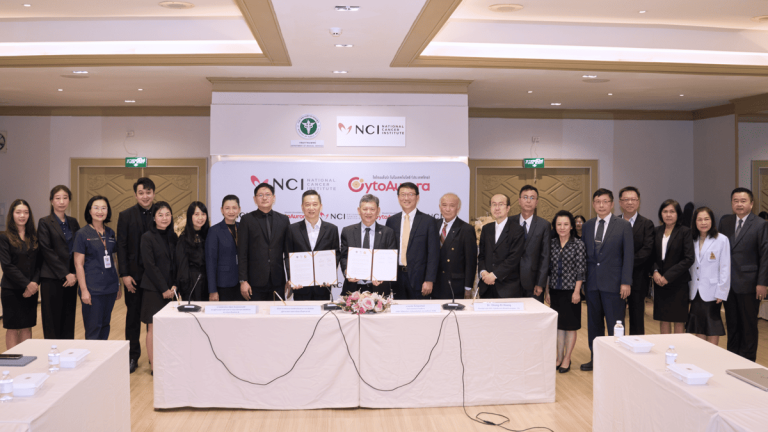
On July 2, 2026, the National Cancer Institute (NCI) and CytoAurora Biotechnology Thailand signed an MOU to advance cancer research and innovation, alongside an international academic forum to promote precision medicine in Thailand.
The National Cancer Institute (NCI), Department of Medical Services, Ministry of Public Health, in collaboration with CytoAurora Biotechnology (Thailand) Co., Ltd., officially signed a Memorandum of Understanding (MOU) on research and development of innovative cancer medical technologies. The event also featured an international academic symposium, held at the Somchai Sombunjaroen Conference Room, 5th Floor, Damrong Niranudorn Building, National Cancer Institute, with online participation. The ceremony was attended by executives, researchers, and healthcare professionals from across the country.
The event commenced with a welcome report delivered by Dr. Thanarat Imsuwansri, Deputy Director for Academic Affairs and Medical Education, National Cancer Institute. This was followed by the opening remarks and welcome address from Air Chief Marshal Somchai Thanasitthichai, Director of the National Cancer Institute. Dr. Krit Ungvidhursathien, Chairman of the Executive Board of CytoAurora Biotechnology (Thailand) Co., Ltd., then outlined the vision, objectives, and implementation framework of the collaboration before representatives from both organizations officially signed the Memorandum of Understanding.
Strengthening Thailand’s Cancer Care Through Collaborative Innovation
The MOU aims to promote collaborative research and development of innovative cancer technologies by combining the complementary strengths of both organizations. The National Cancer Institute contributes its extensive clinical expertise and patient network, while CytoAurora brings cutting-edge technologies in digital pathology, immune profiling, and cell therapy. This strategic partnership is expected to accelerate the translation of scientific discoveries into clinical applications, ultimately improving cancer diagnosis, treatment, and patient outcomes in Thailand.
International Academic Symposium Showcases Global Medical Innovations
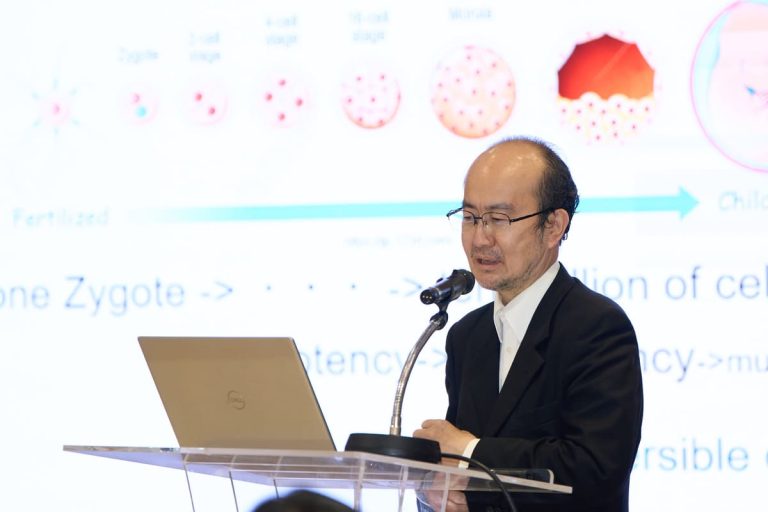
Following the signing ceremony, participants attended an international academic lecture delivered by distinguished global experts. The first session, “Advances in the Application of iPSC Technology from Bench to Bedside: 20 Years After Its Discovery,” was presented by Dr. Shinsuke Yoshida, DMD, MBA, Ph.D., Former Deputy Director of the CiRA Foundation, Kyoto University, Japan.
Dr. Yoshida shared two decades of progress in induced pluripotent stem cell (iPSC) technology since its groundbreaking discovery, highlighting the journey from laboratory research to real-world clinical applications and its transformative potential in regenerative medicine and future cancer therapies.
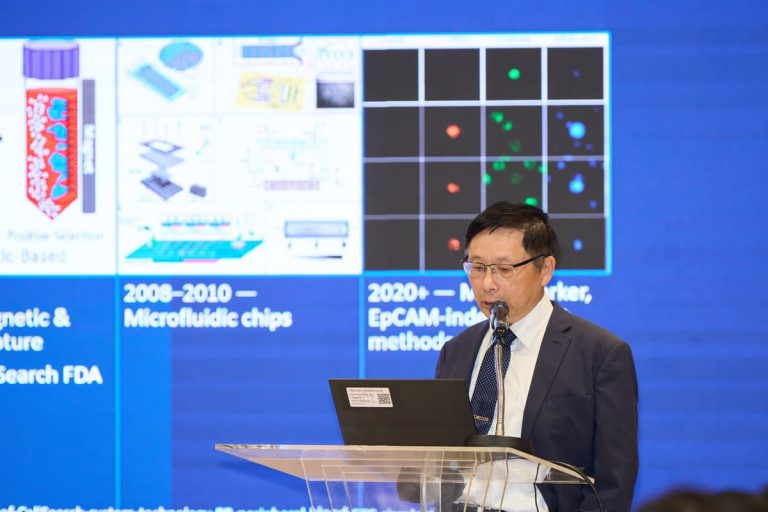
The second session, titled “The Application of CTC Technology in Cancer Treatment: CTCs in the Era of Precision Medicine,” was presented by Professor Jou Hei-Jen, Vice President of the Seventh-day Adventist Hospital and former President of the Taiwan Society for Precision Medicine.
In his lecture, Professor Jou highlighted the critical role of Circulating Tumor Cells (CTCs) in the advancement of precision oncology. He elaborated on how CTC technology can be utilized in the diagnosis, monitoring, and evaluation of cancer treatment with greater accuracy, offering significant potential for improving personalized cancer care and treatment outcomes in the era of precision medicine.
Understanding iPSC and CTC Technologies
Induced Pluripotent Stem Cell (iPSC) technology refers to a type of stem cell generated by reprogramming ordinary somatic cells, such as skin cells or blood cells, to revert them to a pluripotent state similar to that of embryonic stem cells. These cells possess the ability to differentiate into virtually any cell type in the human body as needed.
This groundbreaking technology was first discovered by Professor Shinya Yamanaka in 2006, an achievement that later led to the awarding of the Nobel Prize in Physiology or Medicine in 2012.
Today, iPSC technology is widely applied in basic biomedical research, particularly in disease modeling and drug screening, enabling scientists to study disease mechanisms and test therapeutic agents at the cellular level. It is also rapidly advancing toward clinical application as a foundation for cell therapy, offering potential treatment options for diseases that currently have no cure.
Meanwhile, Circulating Tumor Cell (CTC) technology represents a form of liquid biopsy that enables the detection and analysis of cancer cells circulating in the bloodstream through a simple blood draw, without the need for conventional tissue biopsy, which is more invasive and carries higher risk and discomfort.
CTC technology plays a crucial role in early cancer diagnosis, assessment of metastasis, real-time monitoring of treatment response, and early detection of drug resistance or disease recurrence—often before abnormalities can be identified through medical imaging. As such, it is considered one of the key pillars of precision medicine in modern oncology.
Products and Services Supporting the Collaboration at CytoAurora
CytoAurora Biotechnology (Thailand) provides a comprehensive portfolio of medical technologies across four main areas:
- Circulating Tumor Cell (CTC) technology for liquid biopsy applications, enabling highly precise cancer diagnosis and treatment monitoring.
- Digital Pathology / Whole Slide Imaging (WSI) systems for scanning, storing, and analyzing pathological slides digitally, allowing pathologists to provide accurate and efficient remote diagnosis and consultation.
- Immunotherapy, which focuses on analyzing and enhancing the patient’s immune system to target and eliminate cancer cells in a highly specific manner.
- Induced Pluripotent Stem Cell (iPSC) technology, which serves as a foundational platform for the future development of cell-based therapies.
The integration of these technologies with the clinical network of the National Cancer Institute of Thailand is expected to significantly enhance the country’s cancer care ecosystem, creating a more comprehensive diagnostic and treatment pathway—from the cellular level to clinical application.
Tri-Nation Collaboration Driving Innovation: Japan, Taiwan, and Thailand
On this occasion, Mr. Hiroaki Kawamura, Member of the Chiba Prefectural Assembly, Japan, attended the event as a distinguished guest. He has played a key role in facilitating and promoting collaboration between CytoAurora Biotechnology and Chiba University, one of Japan’s leading academic institutions specializing in medical science and biotechnology.
Mr. Kawamura emphasized that this trilateral collaboration among Japan, Taiwan, and Thailand represents a significant milestone for the advancement of medicine in the Asia region.
The integration of Japan’s expertise in iPSC stem cell technology, Taiwan’s advancement in CTC technology, and Thailand’s strong clinical network and public health infrastructure is expected to create a robust foundation for long-term improvements in cancer diagnosis and treatment standards across the region. It also opens new opportunities for cross-border medical research and innovation that can benefit patients in all participating countries.
Benefits for Thailand
This collaboration will enable Thailand to directly access advanced medical knowledge and technologies from leading experts in Japan and Taiwan. It will also strengthen the capacity of Thai researchers and physicians in the fields of precision medicine and regenerative medicine, which are among the most rapidly developing areas of global healthcare innovation.
Furthermore, it will support the development of Thailand’s national cancer research infrastructure, particularly in digital pathology and immune profiling technologies, helping the country move toward becoming a regional hub for medical and biotechnology innovation in ASEAN in the long term.
Benefits for Thai Patients and the Public
For cancer patients and the general public in Thailand, this collaboration is expected to significantly improve access to advanced diagnostic and treatment technologies within the country, reducing the need to seek medical care abroad.
CTC technology will enable more precise cancer detection and treatment monitoring through minimally invasive procedures, reducing the pain and risks associated with traditional tissue biopsy. Meanwhile, iPSC technology will serve as a critical foundation for the future development of cell-based therapies.
Overall, these advancements are expected to accelerate early cancer detection, improve diagnostic accuracy, enhance treatment effectiveness, and ultimately improve the long-term quality of life for cancer patients in Thailand.
About the National Cancer Institute
The National Cancer Institute, Department of Medical Services, Ministry of Public Health, serves as Thailand’s leading national center for cancer prevention, diagnosis, treatment, and research. It is dedicated to advancing medical knowledge in oncology for the benefit of the Thai population.
About CytoAurora Biotechnology (Thailand)
CytoAurora Biotechnology (Thailand) Co., Ltd. is a medical technology company specializing in cancer diagnostics, digital pathology, immune profiling, and cell therapy technologies. The company aims to introduce world-class medical innovations to enhance cancer care and treatment outcomes in Thailand.